Introduction –
In India, GST compliance has become a necessary part of running a small business smoothly and legally. Many small and medium businesses have taken GST registration because it is required for compliance and also offers multiple practical benefits.
For a small business owner, GST can feel complex in the beginning, but if the right process is followed step-by-step, compliance becomes manageable. The key is to focus on correct registration, understanding tax slabs, timely return filing, proper invoicing, complete documentation, and smart use of technology.
Main Discussion –
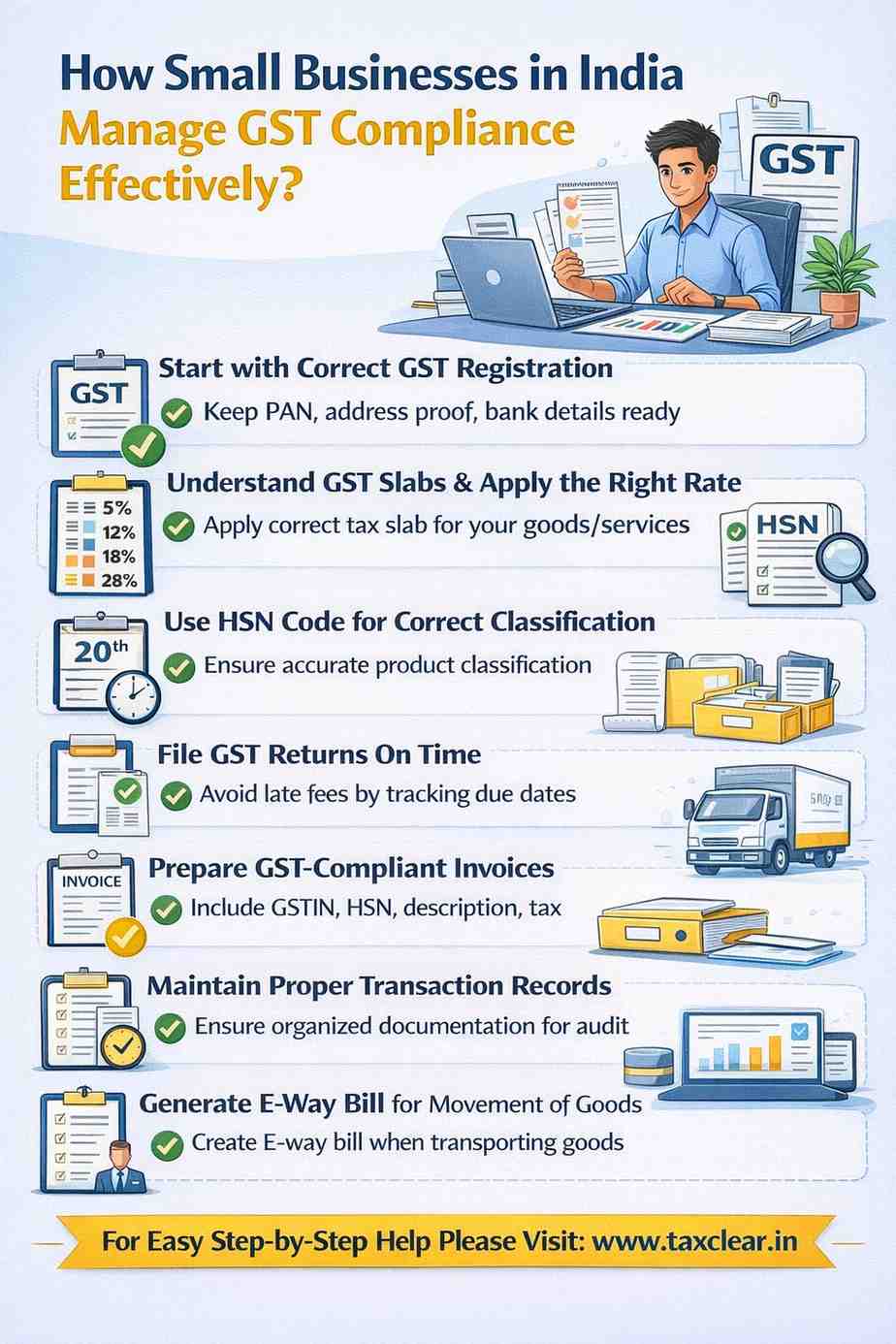
1) Start with correct GST registration
For GST registration, some basic business documents must be ready in advance. These typically include:
- Business registration papers
- PAN card
- Address proof
- Bank account details
After that, the business needs to visit the GST portal and fill the registration form carefully with correct details. Once the process is completed successfully, a GST number is issued which becomes the identification of the business for GST purposes.
2) Understand GST slabs and apply the right rate
After registration, it is very important to understand GST tax slabs. Under GST, different goods and services are placed into different slabs. The expert discussion explains that slabs generally include categories such as:
- Lower slab items and essential goods/services
- Medium slab goods including processed goods and capital goods
- Higher slab consumer goods and electronic items
- Luxury and high-rated goods
The key compliance point is that a business must apply the correct tax slab to its goods or services. Wrong slab selection can create calculation errors and compliance issues later.
3) Use HSN code for correct product classification
To choose the right slab properly, small businesses should understand the importance of the Harmonized System of Nomenclature (HSN code).
The HSN code helps in classifying and identifying products correctly. Each product gets a unique HSN code based on its characteristics and components. This makes taxation and regulation easier and helps ensure correct GST treatment.
4) Make timely GST payment and return filing a routine
Timely payment and filing is a major part of GST compliance. Normally, GST returns are required to be filed monthly, and deadlines should be followed strictly to avoid late fees.
GST payments can be made online or through challan, depending on the business process. The practical habit that works best is maintaining a fixed monthly schedule so that filing never gets delayed.
5) Prepare GST-compliant invoices properly
For small businesses, GST-compliant invoicing is very important. An invoice must include specific details so that it remains valid for GST records.
The discussion highlights key invoice details such as:
- Your GST number
- Customer GST number (if applicable)
- HSN code
- Product description
- Tax amount
Correct invoicing ensures that business transactions remain clean, traceable, and compliant.
6) Maintain proper documentation of all transactions
GST compliance is not only about filing returns. It also requires that every transaction is supported by proper documentation.
Maintaining orderly records helps in day-to-day business clarity and also becomes critical if the business is ever reviewed or checked by authorities. When documentation is complete and accurate, compliance becomes smooth.
7) Generate E-way bill for movement of goods
When goods are transported from one state to another, generating an E-way bill becomes an important compliance step. The E-way bill contains details such as:
- GST details
- Transportation information
This can be generated through the GST portal or mobile app. Businesses involved in movement of goods must ensure this step is not missed.
8) Be prepared for audits through clean records
The GST department conducts audits regularly. If a business is selected for audit, financial records and documentation may need to be produced before the GST officer.
This is why maintaining proper transaction data and records is not optional—it directly supports smooth audit handling.
9) Use technology to reduce mistakes and save time
Technology plays a major role in effective GST compliance for small businesses. The discussion clearly explains that:
- Manual data entry increases chances of mistakes
- Software and apps reduce errors through pre-defined formulas
- Technology protects data and avoids wrong calculations
- Automation saves time by handling repetitive tasks
- Reports can be generated easily and analysed properly
- Software gives timely updates when GST rules change
- Strong data security helps protect sensitive financial data
For small businesses, using a billing/accounting system simplifies GST compliance and improves overall efficiency.
Practical Impact / Expert View
From a practical CA-style compliance view, GST becomes easy when small businesses follow a structured approach:
- registration done correctly
- slab and HSN selection done carefully
- returns filed on time
- invoices created with correct details
- documentation maintained properly
- E-way bill generated when required
- technology used to reduce errors and automate work
This keeps the business fully legal and transparent and avoids unnecessary compliance stress.
Conclusion – key takeaways –
- GST registration is essential and beneficial for small businesses
- Proper documents must be ready for registration and details must be filed correctly
- Understanding tax slabs and HSN codes prevents wrong tax application
- Timely return filing and GST payment helps avoid late fees
- GST-compliant invoicing and transaction documentation are critical
- E-way bill is necessary for inter-state movement of goods
- Regular audits make proper record-keeping important
- Technology and software help reduce mistakes, save time, and stay updated
For professional support and advisory, you may reach out at casgpj@gmail.com or WhatsApp +91 81715 82583.



Leave a Reply