
Introduction – Main Discussion
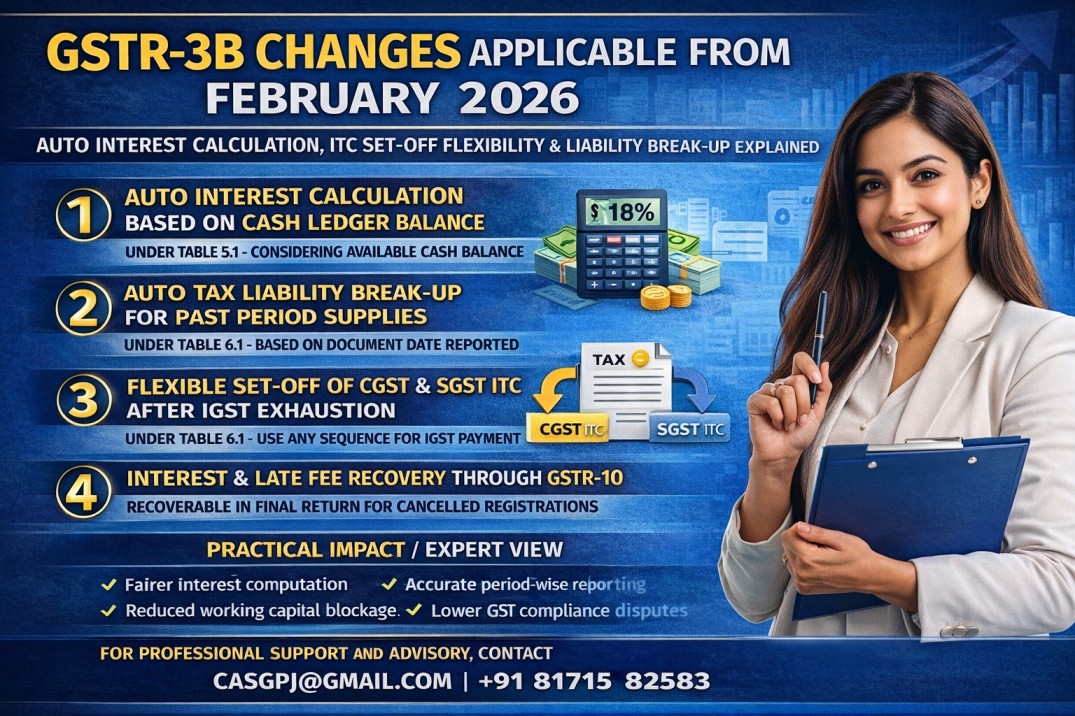
From the February 2026 return cycle, several important system-driven changes are being activated in GSTR-3B on the GST portal. These changes apply to returns pertaining to the January 2026 tax period onwards and are based on a formal GST portal advisory.
The objective behind these changes is to make interest computation, tax liability reporting, and ITC utilisation more accurate, automated, and aligned with statutory provisions, while reducing manual errors and working capital blockage. This article discusses only one consolidated topic—the key changes introduced in GSTR-3B, strictly based on the expert discussion.
Main Discussion
1. Auto Interest Computation Considering Cash Ledger Balance (Table 5.1)
A major change has been introduced in Table 5.1 of GSTR-3B, which deals with interest and late fee calculation.
Earlier, even if sufficient balance was already available in the electronic cash ledger, the GST portal did not consider this balance while computing interest on delayed filing. This resulted in excess interest demands, despite the taxpayer having already deposited funds.
From the January 2026 tax period:
- The portal will automatically compute interest by giving benefit of the minimum cash balance available in the electronic cash ledger from the due date of return till the date of tax payment.
- Interest will be calculated only on the net unpaid portion of tax.
Relevant statutory reference (as reflected in the advisory):
Interest computation will be aligned with the provisions of Rule 88B(1) of the CGST Rules.
The auto-populated interest amount:
- Represents the minimum interest payable
- Cannot be reduced by the taxpayer
- Can be increased upward if self-assessment shows higher liability
This change ensures fairness while maintaining taxpayer responsibility for correct self-assessment.
2. Auto-Population of Tax Liability Break-up for Past Period Supplies
Another important enhancement relates to auto-population of tax liability break-up in GSTR-3B where supplies of earlier tax periods are reported in the current return.
If a taxpayer reports any supply of a previous tax period in the current GSTR-1 or IFF, and discharges tax in the current GSTR-3B:
- The portal will automatically populate the tax liability break-up in GSTR-3B
- The break-up will be based on the document date reported in GSTR-1 / GSTR-1A / IFF
This improves:
- Period-wise accuracy of tax reporting
- Correct computation of interest under Section 50
- Alignment between GSTR-1 data and GSTR-3B liability
The auto-populated values remain suggestive in nature, and taxpayers may modify them upward if required, but not downward.
3. Flexible Cross-Utilisation of ITC After IGST Exhaustion (Table 6.1)
A significant relief is introduced in Table 6.1 – Payment of Tax, dealing with ITC utilisation.
Earlier, after exhausting IGST credit, the system followed a rigid order for utilisation of CGST and SGST credits, often leading to:
- Imbalance between CGST and SGST ledgers
- Forced cash payments despite ITC availability
- Unnecessary working capital blockage
From January 2026 onwards:
- Once IGST ITC is fully exhausted
- The portal will allow CGST and SGST ITC to be utilised in any sequence for payment of IGST liability
This change provides flexibility and corrects a long-standing practical difficulty faced by taxpayers.
4. Recovery of Interest and Late Fee Through GSTR-10
For cancelled registrations, a new recovery mechanism has been enabled.
If the last applicable GSTR-3B is filed after the due date:
- Interest and late fee related to such delayed GSTR-3B
- Can now be recovered through GSTR-10 (Final Return)
This closes a system gap where recovery was earlier not possible once registration was cancelled.
Practical Impact / Expert View
These changes indicate a shift towards a smarter, system-driven GST compliance framework. The portal is now leveraging available ledger data and document dates to reduce manual intervention.
Key benefits include:
- Fair interest computation
- Accurate period-wise liability reporting
- Reduced working capital blockage
- Better alignment with statutory provisions
- Lower compliance disputes
However, taxpayers must note that downward editing of system-calculated figures is not permitted, and correct self-assessment remains critical.
Conclusion – Key Takeaways
- GSTR-3B changes apply from January 2026 tax period (filed in February 2026)
- Interest will be auto-calculated considering cash ledger balance
- Tax liability break-up for past period supplies will auto-populate
- CGST and SGST ITC can be flexibly utilised after IGST exhaustion
- Interest and late fee can be recovered through GSTR-10 for cancelled registrations
- Auto-populated values are minimum and non-reducible



Leave a Reply