
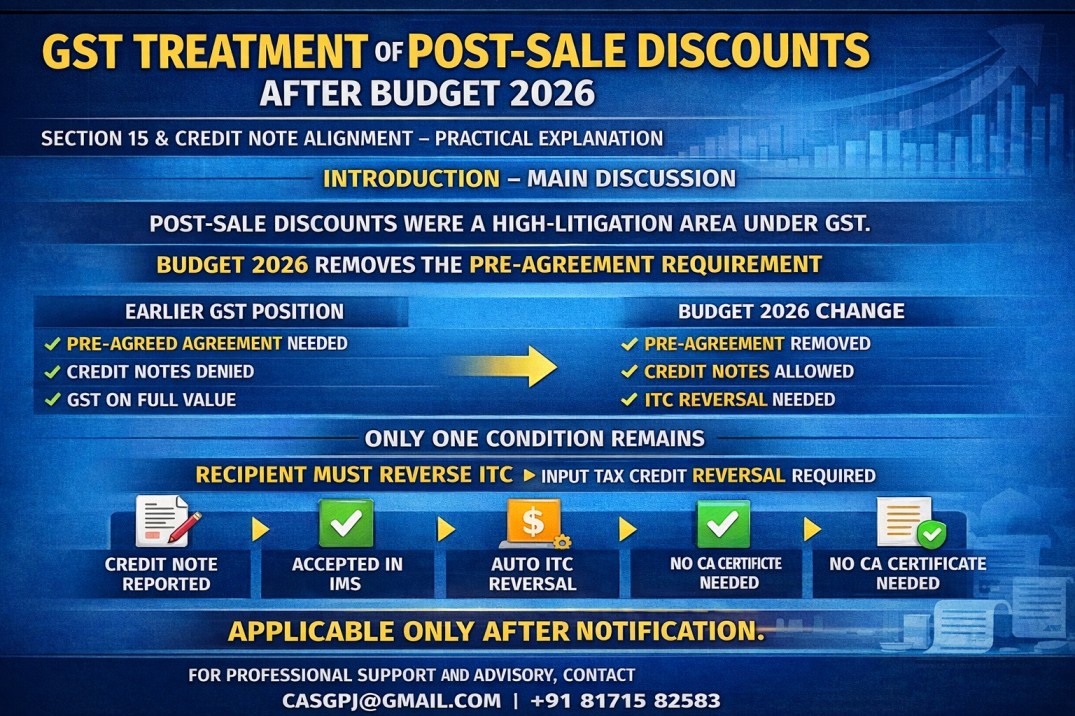
Introduction – Main Discussion
Post-sale discounts have long been one of the most litigated areas under GST valuation. The core issue has been whether a discount offered after the supply can reduce the taxable value and corresponding GST liability. Budget 2026 has proposed targeted changes to address this long-standing dispute by simplifying the conditions for allowing post-sale discounts through credit notes.
This article explains the proposed change in a practical, compliance-focused manner, strictly based on the expert discussion, and outlines how businesses should prepare while awaiting official notifications.
Main Discussion
Earlier GST Position on Post-Sale Discounts
Under the existing framework of GST valuation, post-sale discounts were allowed as a deduction from the taxable value only if multiple conditions were satisfied. The most critical condition was that the discount had to be pre-agreed before the supply, typically through a prior agreement or arrangement.
In practice, this led to frequent disputes because many commercial discounts—such as year-end discounts, volume-based incentives, or performance discounts—are finalized after the supply is completed. Tax authorities often denied reduction in GST value on the ground that no prior agreement existed, even if a credit note was issued and tax was reversed.
This resulted in:
- Denial of value reduction despite genuine commercial discounts
- Disallowance of GST adjustment through credit notes
- Repeated litigation and uncertainty for suppliers
Proposed Change in Budget 2026
To address this issue, Budget 2026 proposes a rationalisation of the law relating to post-sale discounts by aligning the valuation provisions with credit note provisions.
The key proposed change is removal of the requirement of a pre-supply agreement for post-sale discounts. Earlier, even if a discount was genuine and supported by a credit note, absence of a prior agreement was enough to deny the benefit. This condition is proposed to be removed to eliminate unnecessary litigation.
After the amendment:
- Post-sale discounts will be allowed even if not pre-agreed
- Linking the discount to the original invoice is no longer required
- The only substantive condition will be reversal of input tax credit by the recipient
The credit note mechanism under the GST law will continue to apply, ensuring proper tax adjustment and audit trail.
Input Tax Credit Reversal – The Sole Condition
The proposed framework places emphasis on one clear compliance requirement:
the recipient must reverse the proportionate input tax credit attributable to the discount.
With the introduction of the Invoice Management System (IMS), this process becomes significantly easier. When a supplier reports a credit note:
- The recipient can accept the credit note in IMS
- The system ensures automatic reversal of eligible ITC
- No separate certification or procedural burden is required
This simplifies compliance and reduces disputes over whether ITC reversal has actually taken place.
Practical Impact / Expert View
From a practical standpoint, this amendment reflects commercial reality. Discounts are a common business practice and often crystallize after supply based on turnover, targets, or market conditions. The earlier requirement of a pre-supply agreement was not aligned with how businesses operate.
Key practical implications include:
- Reduced litigation on post-sale discounts
- Greater certainty in GST valuation
- Easier reconciliation between supplier credit notes and recipient ITC
- Improved working capital management for suppliers
However, it is important to note that these changes will apply only after official notifications are issued. Until then, the existing legal position continues to apply.
Conclusion – Key Takeaways
- Post-sale discounts have been a major source of GST disputes due to rigid valuation conditions
- Budget 2026 proposes removal of the pre-agreement requirement for such discounts
- Credit notes will be allowed to reduce taxable value if recipient reverses ITC
- IMS will play a central role in ensuring smooth ITC reversal and compliance
- Amendments will become applicable only after formal notifications are issued
Businesses should review their discount policies and be ready to align documentation and systems once the changes are notified.



Leave a Reply