
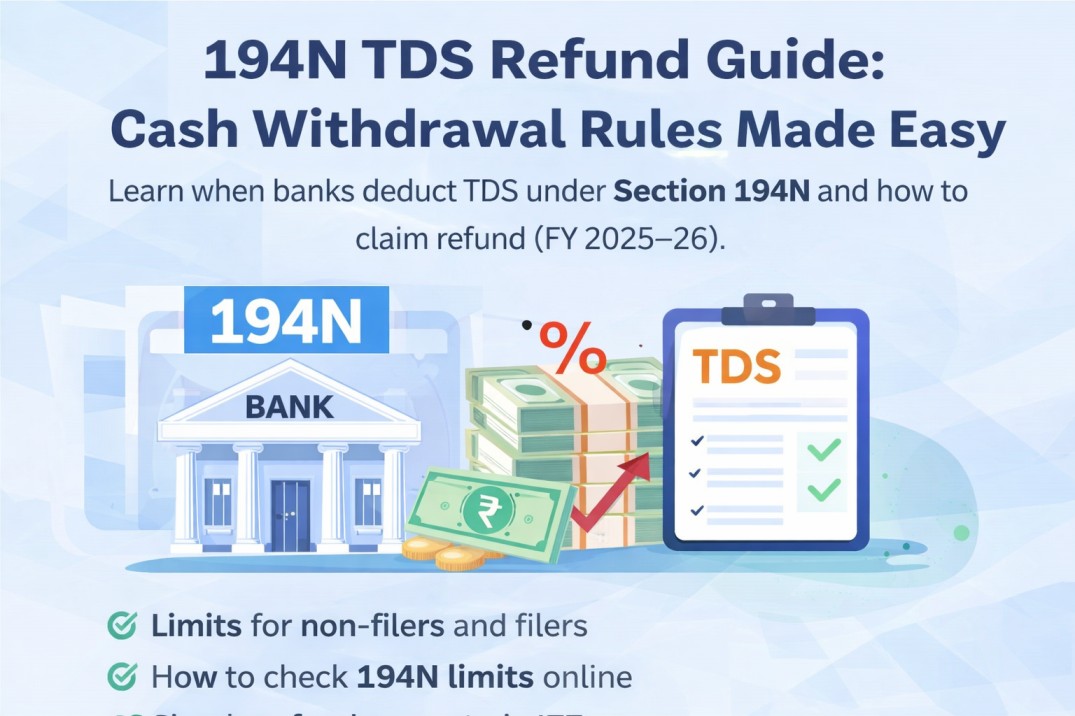
Cash still plays a major role in day-to-day transactions. However, once you decide to use large cash withdrawals from your own bank account, you must follow strict Income Tax compliance rules.
One key provision is Section 194N, which allows banks and similar institutions to deduct TDS on cash withdrawals once you cross specified limits in a financial year. This deduction can surprise taxpayers because it applies even when you withdraw your own money. Therefore, it is important to understand the limits, rates, and compliance steps for FY 2025–26 (1 April 2025 to 31 March 2026).
What Section 194N covers (legal trigger)
Section 194N applies when a person withdraws cash beyond the prescribed threshold during the financial year. The law uses clear language such as “in cash exceeding one crore rupees during the previous year” and requires the bank to “deduct an amount equal to two per cent of such sum, as income-tax”.
In practical terms, TDS starts only after the threshold is crossed, and the bank deducts it at the time of cash payment.
Who deducts the TDS?
The responsibility is not on the taxpayer. Instead, the following entities deduct TDS:
- Banks (public, private, co-operative)
- Post office
Which withdrawals are covered?
TDS under Section 194N can apply to multiple cash withdrawal methods, such as:
- Withdrawal at branch counter
- ATM cash withdrawals
- Self-cheque withdrawals (including cases where the cheque is not crossed)
- Cash withdrawal at maturity of deposits, if paid in cash
So, the mode does not matter. The aggregate cash withdrawal in the year matters.
Limits and rates (based on ITR filing status)
Section 194N works differently depending on whether you have filed ITRs for the last three relevant years.
If you have NOT filed ITRs for all of the last 3 relevant assessment years:
- No TDS up to ₹20 lakh
- 2% TDS from ₹20 lakh to ₹1 crore
- 5% TDS on amount exceeding ₹1 crore
If you HAVE filed ITRs (all or any one) for the last 3 relevant assessment years:
- No TDS up to ₹1 crore
- 2% TDS on amount exceeding ₹1 crore
This is a strong compliance signal: regular ITR filing increases the non-TDS withdrawal limit.
Bank-wise limit concept (important practical point)
The cash withdrawal limit is generally bank-wise and tracks your total withdrawals under the same bank (often linked through your customer ID). So, withdrawals across multiple branches of the same bank still get aggregated.
At the same time, if you withdraw from different banks, each bank checks the threshold separately (as per its own records).
Important exceptions (where TDS may not apply)
Certain withdrawals do not attract TDS under 194N, such as cash payments made to specific exempt persons like government and certain banking channels. Also, some business correspondents may avoid deduction based on prescribed compliance and documentation.
PAN update is non-negotiable
Always ensure your PAN is updated in the bank. If you fail to provide PAN, the bank may deduct TDS at a much higher rate, creating unnecessary blockage of funds and refund issues.
Practical Impact
How to check your applicable 194N rate online
You can verify whether your threshold is ₹20 lakh or ₹1 crore using the “TDS on Cash Withdrawal u/s 194N” service on the Income-tax portal by entering PAN and OTP. This helps you plan cash withdrawals without getting surprised by deduction.
If TDS gets deducted, is the money lost?
No. Treat it like an advance tax credit. The deducted amount reflects against your PAN and appears in:
- AIS / TIS
- Form 26AS
After that, you can claim it while filing your return, depending on your final tax liability.
Can you claim a refund?
Yes, only through ITR filing. If your total tax liability becomes lower than the TDS deducted, you can claim the balance as refund.
Also note: when 194N applies, you may not be eligible to file ITR-1, so you must select the correct ITR form based on your income profile.
Conclusion – key takeaways
- Section 194N can deduct TDS even on your own cash withdrawal
- Limits depend on your last 3 years’ ITR filing compliance
- For non-filers, TDS starts after ₹20 lakh; for filers, after ₹1 crore
- Banks calculate limits financial-year wise and often bank-wise
- Always keep PAN updated, check AIS/26AS, and file ITR to claim refund
- Prefer digital modes (UPI/NEFT/RTGS) to reduce cash-compliance friction
For professional support and advisory, you may reach out at casgpj@gmail.com or WhatsApp +91 81715 82583.



Leave a Reply